
How Attackers Move Between Linux Servers — And How to Detect Lateral Movement Before It's Too Late
Imagine managing 20 Linux servers across different environments.
One hosts your website. Another runs your application. A third manages your database. Others handle backups, APIs, internal services, and business-critical applications.
Everything appears normal until one server is compromised.
The security team detects suspicious SSH activity. A few minutes later, another server records an unexpected login. Then an unfamiliar systemd service appears. Shortly afterwards, unusual network connections begin originating from the second server.
Are these separate security events?
Or is someone moving through your infrastructure?
This is where one of the most important concepts in modern cybersecurity becomes critical: Lateral Movement.
For organisations managing multiple Linux servers, understanding lateral movement is no longer optional. A single compromised machine can become an entry point into a much larger infrastructure attack.
Let's examine how it happens, what security analysts should look for, and how organisations can detect suspicious activity before it spreads.
1. What Is Lateral Movement?
Lateral Movement refers to techniques attackers use to move from one compromised system to another within an environment.
After gaining initial access to a server, an attacker may attempt to discover other systems, obtain credentials, abuse existing permissions, and access additional machines.
The objective may include:
- Accessing sensitive databases.
- Reaching internal application servers.
- Compromising backup infrastructure.
- Obtaining privileged credentials.
- Expanding access across the network.
- Disabling security controls.
- Collecting and exfiltrating sensitive information.
An attacker does not necessarily need to exploit a new vulnerability on every server.
Sometimes, legitimate administrative access mechanisms, stolen credentials, or poorly configured permissions provide the opportunity to move further into the environment.
The important point: A compromised server should never be treated as an isolated incident until the surrounding infrastructure has been investigated.
2. How One Compromised Server Can Put Others at Risk
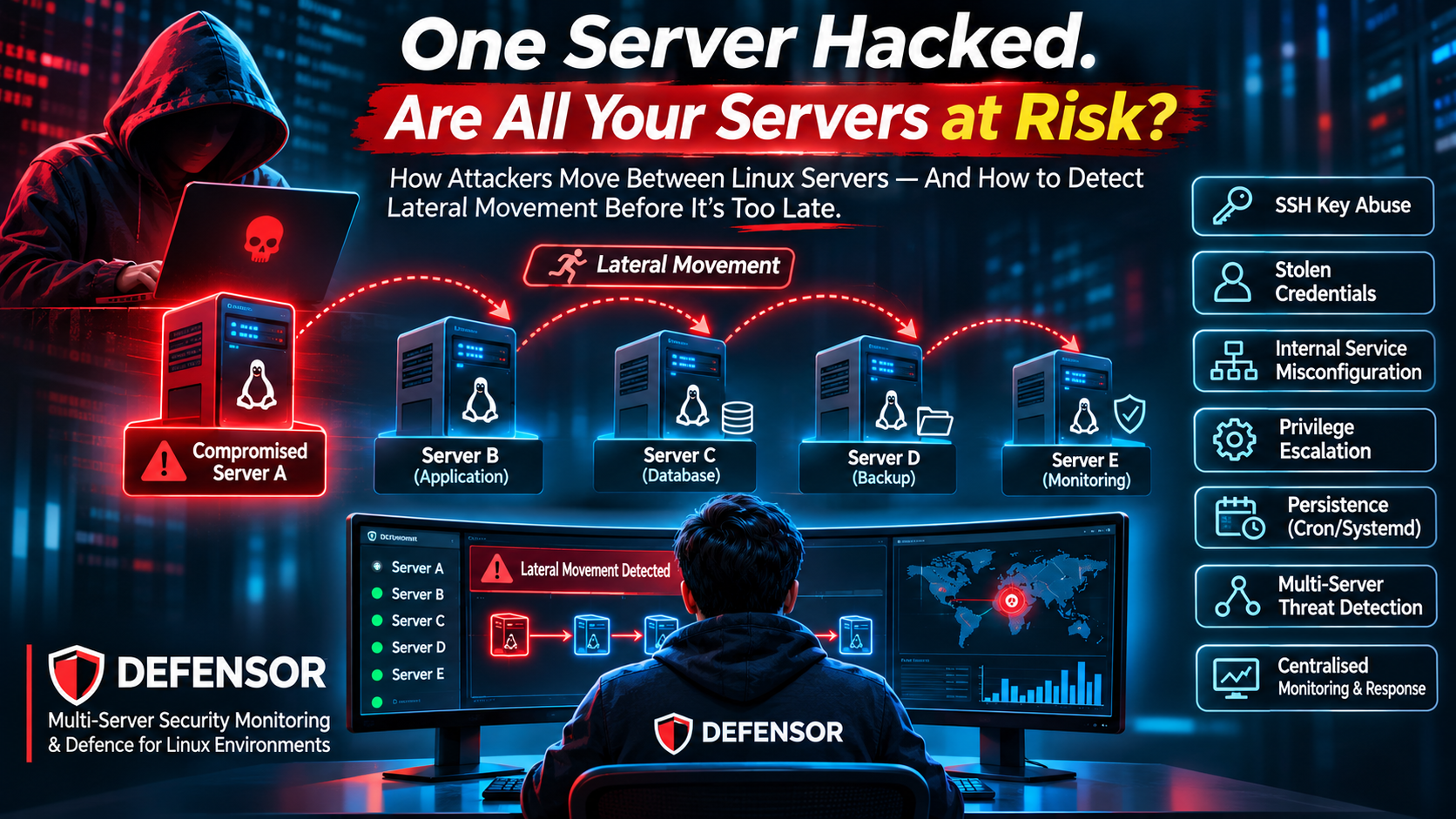
Consider a typical organisation managing five Linux servers.
| Server | Primary Function |
|---|---|
| Server A | Web Server |
| Server B | Application Server |
| Server C | Database Server |
| Server D | Backup Server |
| Server E | Monitoring Server |
Suppose Server A is compromised through an exposed application vulnerability.
The attacker may then attempt to:
- Discover internal services and connected systems.
- Identify accessible credentials and SSH configurations.
- Search for accounts with excessive permissions.
- Attempt access to Server B.
- Investigate database connectivity to Server C.
- Identify backup infrastructure on Server D.
- Attempt to interfere with security monitoring.
This is an illustrative attack scenario, not a guaranteed sequence. Actual attack paths depend on network architecture, permissions, security controls, and available credentials.
The security risk becomes significantly greater when servers share credentials, trust relationships, or unrestricted internal access.
3. Five Common Ways Attackers Move Between Linux Servers
Understanding the techniques is essential for anyone responsible for Linux infrastructure security.
3.1 SSH Key Abuse
SSH key authentication is widely used for secure remote administration.
However, improperly managed private keys can become a serious security risk.
If an attacker obtains access to a private key that is authorised on another server, they may be able to use that key to attempt authentication.
Important locations to investigate include:
~/.ssh/authorized_keys~/.ssh/known_hosts/etc/ssh/sshd_config
What analysts should monitor:
- Unexpected SSH key additions.
- Changes to authorised keys.
- Unusual SSH authentication activity.
- Connections between servers that do not normally communicate.
- Authentication using unexpected accounts.
SSH key management should include restricted permissions, key rotation, access reviews, and removal of obsolete keys.
3.2 Stolen Credentials and Password Reuse
Credential compromise is another common path to lateral movement.
Imagine an administrator using the same password across multiple Linux servers.
If one account becomes compromised, other systems using the same credentials may also be exposed.
Security teams should monitor:
- Authentication from unfamiliar IP addresses.
- Unexpected login times.
- The same account accessing multiple servers unusually quickly.
- Unusual privileged account activity.
- Unexpected authentication failures followed by successful access.
Using unique credentials, MFA where supported, and least-privilege access significantly reduces this risk.
3.3 Misconfigured Internal Services
Internal services are often trusted more than publicly exposed services.
That assumption can create security gaps.
For example, a database server may accept connections from an application server, but unnecessary network access or weak authentication can increase the attack surface.
Common service ports worth understanding include:
| Service | Default Port |
|---|---|
| SSH | 22 |
| MySQL | 3306 |
| PostgreSQL | 5432 |
| Redis | 6379 |
| MongoDB | 27017 |
Security analysts should investigate:
- Unexpected internal connections.
- Unusual database authentication.
- Unnecessary exposed services.
- Unexpected port scanning.
- Changes in normal server communication patterns.
A service listening on a port is not automatically vulnerable. Its exposure, configuration, authentication, and access requirements must be evaluated.
3.4 Privilege Escalation
An attacker who initially accesses a server with limited permissions may attempt to obtain greater privileges.
Potential weaknesses include:
- Misconfigured sudo permissions.
- Vulnerable software.
- Incorrect file permissions.
- Unsafe SUID binaries.
- Excessive administrative privileges.
Analysts should investigate unexpected privilege changes, suspicious process execution, and modifications to sensitive system files.
3.5 Persistence Through Cron and Systemd
Maintaining access after an initial compromise is another important attacker objective.
Linux persistence mechanisms may involve:
- Cron jobs.
- Systemd services.
- SSH authorised keys.
- Shell startup files.
- Startup scripts.
Unexpected changes to these locations should trigger investigation.
However, legitimate software installations and administrative maintenance also modify these files. Detection must consider ownership, file history, expected configuration, and surrounding events.
4. The Hidden Warning Signs: What Security Analysts Should Look For
A successful security investigation rarely depends on one event.
The real value comes from correlating multiple indicators.
Consider these observations:
Event 1: Server A records an unusual SSH login.
Event 2: Server A shows unexpected privileged activity.
Event 3: Server B records a new SSH login originating from Server A.
Event 4: Server B reports an unexpected systemd configuration change.
Event 5: Server B starts communicating with an unfamiliar external destination.
Individually, these events may have legitimate explanations.
Together, they form a suspicious sequence that deserves immediate investigation.
Important detection indicators include:
| Indicator | What It May Suggest |
|---|---|
| Unusual SSH login | Possible credential compromise |
| New SSH authorised key | Potential persistence |
| Unexpected sudo activity | Possible privilege escalation |
| New systemd service | Possible persistence |
| Internal connection spikes | Possible lateral movement |
| Unusual process execution | Possible malicious activity |
| Unexpected outbound traffic | Potential data exfiltration |
The objective is not to classify every anomaly as an attack.
It is to identify meaningful patterns that require investigation.
5. Why Monitoring Each Server Separately Is Not Enough
Consider an organisation monitoring 30 Linux servers.
If every server generates security logs independently, analysts may have to investigate events across multiple systems manually.
This creates several challenges:
- Related events may go unnoticed.
- Attack progression may be difficult to reconstruct.
- Security teams may miss cross-server relationships.
- Investigations take longer.
- Important indicators may remain disconnected.
For example, an SSH login on Server A and an unusual privileged login on Server B may appear unrelated when viewed separately.
But when both events are correlated using timestamps, source addresses, account information, and network relationships, they may reveal a larger incident.
This is why centralised security monitoring is important.
A unified monitoring platform should help security teams understand what is happening across the entire infrastructure rather than looking at individual machines in isolation.
6. How to Detect Lateral Movement on Linux Servers
Practical investigation starts with understanding normal server behaviour.
Here are some useful commands for Linux security analysts.
Check SSH authentication events:
sudo grep -E "Accepted|Failed|Invalid user" /var/log/auth.logReview recent SSH service events:
sudo journalctl -u ssh --since "24 hours ago"Check active network connections:
sudo ss -tnpIdentify listening services:
sudo ss -tulpnReview privileged group membership:
sudo getent group sudoInspect enabled systemd services:
systemctl list-unit-files --state=enabledCheck cron configuration:
sudo ls -la /etc/cron.d/Review recent system errors:
sudo journalctl -p err -n 100These commands provide useful investigation evidence, but they do not independently prove lateral movement.
Analysts should compare results with established baselines, approved administrative activity, and historical system behaviour.
7. How MITRE ATT&CK Helps Investigate Lateral Movement
The MITRE ATT&CK framework provides a structured way to understand adversary behaviour.
Some relevant techniques include:
- T1021 – Remote Services: Attackers use remote services to access other systems.
- T1550 – Use Alternate Authentication Material: Attackers abuse authentication materials such as stolen tokens.
- T1078 – Valid Accounts: Legitimate accounts are abused for unauthorised access.
- T1053 – Scheduled Task/Job: Scheduled mechanisms may be abused for execution and persistence.
- T1543 – Create or Modify System Process: System processes and services may be created or modified for persistence.
Mapping investigation evidence to MITRE ATT&CK helps analysts communicate findings, identify detection gaps, and improve security coverage.
Reference: https://attack.mitre.org/
8. What Organisations Should Do to Prevent Cross-Server Compromise
Preventing lateral movement requires multiple layers of security.
Network Segmentation
Separate web, application, database, and backup environments.
Only allow the connections required for legitimate operations.
Strong SSH Security
- Disable unnecessary SSH access.
- Use unique credentials.
- Protect private keys.
- Review authorised keys regularly.
- Restrict administrative access.
- Implement MFA where possible.
Least-Privilege Access
Users and services should receive only the permissions necessary to perform their responsibilities.
Continuous Persistence Monitoring
Monitor changes to cron jobs, systemd services, SSH keys, startup files, and other sensitive configuration locations.
Vulnerability Management
Maintain an accurate asset inventory, prioritise exposed vulnerabilities, and apply security patches.
Centralised Security Monitoring
Collect and correlate relevant events from all managed servers.
Most importantly, ensure that security monitoring infrastructure itself is protected against unauthorised modification.
9. Why Multi-Server Threat Detection Matters
Modern infrastructure requires a broader security perspective.
An organisation may operate servers across different applications, environments, and locations.
Security analysts need a unified way to investigate:
- Which server experienced the first suspicious event?
- Which other servers communicated with it?
- Were shared credentials or SSH keys involved?
- Did any privileged account behave unexpectedly?
- Were new persistence mechanisms introduced?
- Was sensitive data accessed or transferred?
- Are other systems showing related indicators?
A modern multi-server monitoring platform should provide:
- Centralised security event collection.
- Cross-server event correlation.
- SSH and identity monitoring.
- Linux persistence detection.
- Suspicious process and network activity monitoring.
- Incident timelines.
- Evidence-based security alerts.
- Investigation and response guidance.
This approach gives security teams a more complete understanding of infrastructure-wide threats.
10. DEFENSOR: Monitor and Defend Multiple Linux Servers from One Dashboard
When organisations manage multiple Linux servers, security visibility becomes increasingly important.
DEFENSOR is designed to help organisations monitor and investigate security events across multiple Linux servers through a centralised platform.
Instead of relying entirely on isolated server-level monitoring, security teams can work with a unified view of their managed infrastructure.
With capabilities focused on Linux security monitoring, persistence detection, suspicious activity identification, and centralised incident visibility, DEFENSOR aims to help security professionals understand potential threats across their server environments.
The goal is simple:
See more. Investigate faster. Protect your infrastructure.
Explore DEFENSOR:
Conclusion: One Compromised Server Should Never Become an Invisible Infrastructure-Wide Threat
Lateral movement demonstrates why modern cybersecurity cannot focus only on the first point of compromise.
An attacker may enter through one server, abuse legitimate credentials, move through internal systems, establish persistence, and attempt to reach critical infrastructure.
The difference between detecting an isolated event and understanding a larger intrusion often comes down to visibility and event correlation.
For cybersecurity analysts, Linux administrators, and SOC teams, the ability to investigate activity across multiple servers is an essential skill.
Remember:
One server may be the entry point. Your entire infrastructure may be the target.
Don't just monitor individual servers. Understand how they interact, identify suspicious relationships, and investigate the complete attack chain.
DEFENSOR — Centralised Security Monitoring and Defence for Multiple Linux Servers.